Everybody does it. The phone comes out, thumbs move, three words go into the box, and a map appears with pins scattered across a few blocks. It feels productive. It feels like you are solving the problem. You are not. What you have actually done is ask a machine to sort restaurants by how physically close they are to your body, which is a fact about geometry and tells you almost nothing about whether the food is good, whether the place is open, or whether you will be standing in a line for half an hour. The search feels smart. The answer is dumb.
Here is why. When you type pizza near me, you are asking a question you do not actually care about. You do not want the nearest pizza. Nobody wants the nearest pizza. You want good pizza that is open, ready soon, and close enough that getting it does not ruin your evening. Those are four different questions wearing one costume.
Let’s break it down into the questions you should be asking instead. Five of them. Each one narrows the field faster than distance ever will. Seaside Pizza Co. at 4263 Mission Blvd happens to answer all five in Pacific Beach, though the questions matter more than any single answer, because once you have them, you can point them at anything.
Question One: Is It Actually Open Right Now
Distance is useless if the door is locked.
Listings lie. Hours drift with the season, weeknights close early, and nobody updates a directory when they change a schedule in March. You walk twelve minutes on the strength of a listing that says open, and you arrive at a dark window.
So ask the question directly. Check the restaurant’s own website, not the map card. Call if the walk is long.
Seaside publishes its hours on its own site, and on Friday and Saturday nights, the slices run late. That late window is the one nobody plans for, and everybody eventually needs.
Question Two: How Long Until Food Is in My Hand
This is the question the search bar cannot even understand.
Two places are the same distance from you. One has a table, a host, a server, and a check. The other has a window. Same distance on the map. Completely different amounts of your life spent waiting.
Ask yourself something uncomfortable. How much of your last pizza night did you spend not eating pizza? Twenty minutes? Thirty?
Seaside has a walk-up window. Order through the Toast link before you leave, walk over, and take the food. The counterpart takes about two minutes.
Three habits that cut the wait:
- Order ahead. Even ten minutes of lead time changes everything.
- Skip the table when you do not need one.
- Call group orders in. The number is (858) 886-7006.
Question Three: Will This Feed Everyone I Am With
Search results assume you are one person. You usually are not.
Groups break restaurants. Five people with five preferences, one of whom does not eat gluten, one of whom hates pineapple with unusual passion. The nearest pizza place does not solve this. It just gives you a shorter walk to the argument.
Ask what the place does for groups.
- Half-and-half pizzas end the topping fight before it begins.
- Cauliflower crust is available across the specialty pizzas, so nobody sits there eating a salad.
- Catering serves from six to two hundred guests, turning a chaotic beach house dinner into something you actually planned.
I think this is the question that separates a good night from a mediocre one, and it never occurs to anyone until they are already standing on the sidewalk.
Question Four: Do I Want This Now, or Do I Want This Later
Nobody asks this. It might be the most useful one on the list.
Take-and-Bake means you buy an uncooked pizza, carry it home, and put it in the fridge. You bake it whenever you feel like eating. Fourteen inches or sixteen inches. Regular or cauliflower.
Think about what that does to your timeline.
You buy at three in the afternoon when nothing is busy. You eat at eight when everyone else is waiting in a line they could have avoided. Same pizza. Different evening entirely.
Perhaps you are staying in a rental with an oven and have not thought about this once. Most people have not.
Question Five: Is This Actually Worth Eating
The final question, and the only one that survives after the food arrives.
Search results are ranked by star average. A four-point-three tells you almost nothing because it blends people who wanted a table with those who wanted a slice, and those are not the same customers.
Look at the menu instead. Real menus give themselves away.
- Sauce options that are named, not vague. Red, white, BBQ, pesto, olive oil, garlic.
- Toppings a chain would never touch. Shishito peppers, sun-dried tomato, fire-braised chicken.
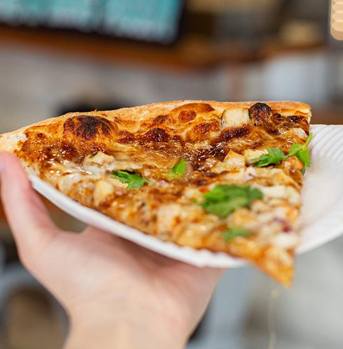
- Pizzas with a point of view. The Cyclops runs red sauce, crispy cupping pepperoni, shishito peppers, and jalapeño. The Master Splinter is white sauce with fire-braised chicken, sun-dried tomato, spinach, and garlic.
Shishito peppers on a pizza in Pacific Beach. That is somebody making a decision, not filling a category.
What the Map Cannot Tell You
Five questions. Open, fast, feeds the group, now or later, worth eating.
Run them in order, and most of the pins disappear before you finish the first one. That is the point. The map gives you distance because distance is easy to measure, not because it matters.
Next steps. Save the menu now, while you are calm and not hungry. Save the number. Decide before you leave the house, not on the sidewalk with four people looking at you.
The nearest pizza and the right pizza are rarely at the same pin, and the distance between them in this neighborhood is about a 4-minute walk. Four minutes is nothing. Spending your evening in a line you could have skipped is something.
