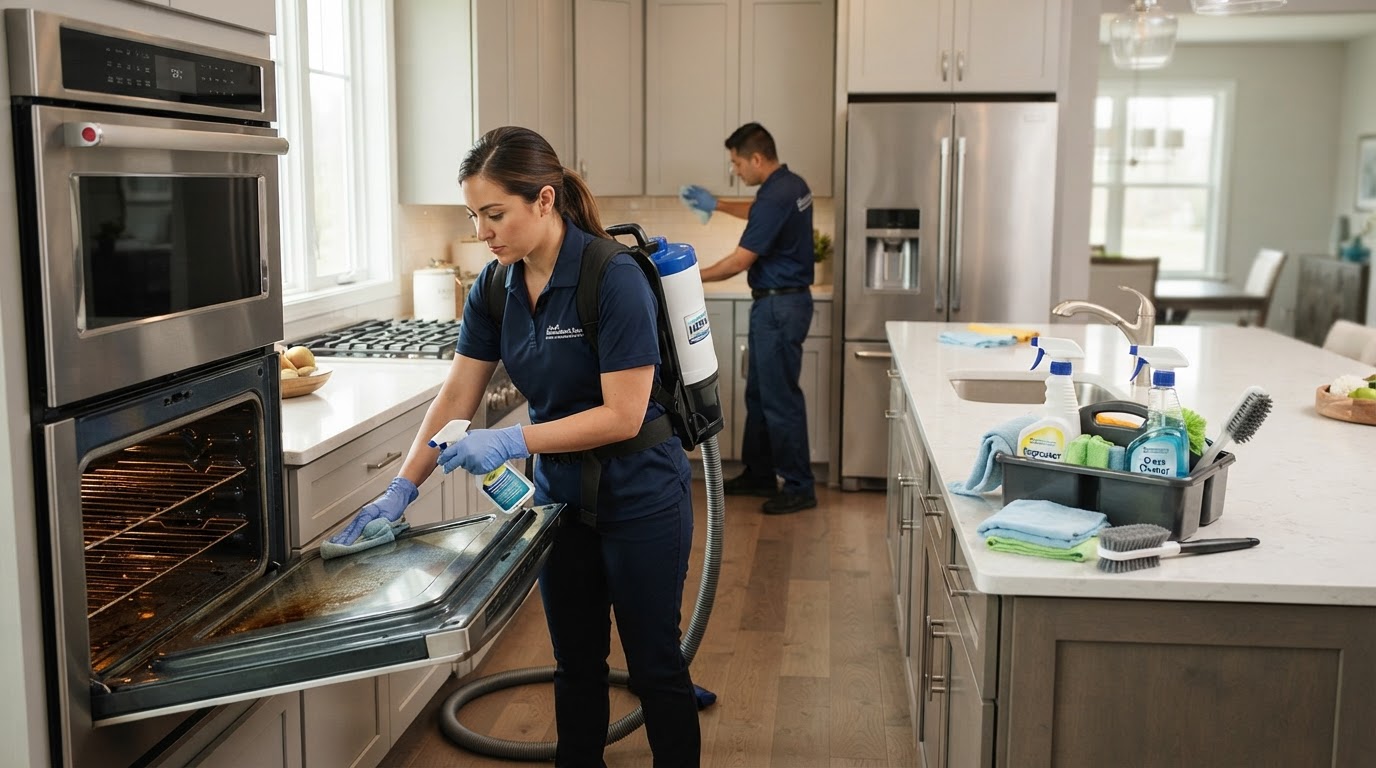
A kitchen can look clean at a glance and still hold months of grease on cupboard fronts, limescale around the taps, and a film of cooking residue above the hob. A deep clean is designed to reach those areas, but the term covers very different jobs depending on the provider, the property, and what has been agreed in advance.
Readers who start by searching for a kitchen deep clean service near me often find quotes that look similar but cover different tasks. Understanding the likely scope before making contact makes those quotes easier to compare, and it helps households avoid paying for work they do not need.
Scope, price, and time are closely linked. A kitchen-only job is usually priced and timed very differently from a whole-home visit, and the gap between the two often comes down to a handful of tasks that are easy to overlook.
What a Kitchen Deep Clean Covers Compared with a Full House Clean
A kitchen-only deep clean concentrates on one room and its fixed surfaces. A whole-home deep clean applies the same method to every room, usually as a single booking with each room itemised. The question "What does a full house deep clean include?" is best answered by separating the kitchen tasks that sit inside that wider scope from those that are treated as extras.
In a kitchen, the standard surfaces are:
- Worktops and upstands, including the join where they meet the wall
- Splashbacks, tiles, and grout
- Cupboard fronts, handles, and the insides of cupboards and drawers
- Sinks, taps, and the drainer area
- Floors, skirting boards, and light switches
Built-in Tasks and Optional Add-Ons
Most providers include surface degreasing, limescale removal from taps and sinks, switches, skirting, and floors in a standard deep clean. Ovens, fridges, extractor filters, and mould removal are more often priced separately, because they require more time, specialist products, or access that the base rate does not cover.
Households should only add what the kitchen actually needs:
- Extractor filters are worth adding if the kitchen has been used for frying or grilling without regular filter cleaning.
- Fridge cleaning is useful before a sale or after a spill, but routine interiors can often be wiped by the household.
- Mould removal is only needed where mould is visible, and it should be assessed before booking because some growth cannot be fully removed (see the section on limitations below).
- Oven cleaning is a separate decision, covered in the next section.
Oven and Appliance Cleaning: What Is Reasonable to Expect
Oven cleaning prices vary widely, and the main drivers are the oven type, the level of carbonised build-up, and whether racks and trays are included. Indicative UK prices for a single domestic oven often sit in the range of roughly £40 to £120, with range cookers, double ovens, and heavily soiled units priced higher. These figures are cost drivers rather than fixed rates, and quotes should be checked against the specific appliance.
Relevant factors include:
- Oven type: Conventional, fan, built-in, and range cookers differ in access and interior construction.
- Build-up level: Light grease can be removed with a standard alkaline product in one application. Heavy carbonised grease may need multiple applications, longer dwell times, or a second visit.
- Self-cleaning or pyrolytic features: Pyrolytic cycles burn residue at high temperatures, leaving ash that must be wiped away. Pyrolytic functions do not remove all grease, and some manufacturers advise against certain chemicals in those ovens.
- Racks and trays: Removing and soaking them adds time, and it should be stated on the quote.
A professional oven clean should cover the interior cavity, inner and outer door glass, racks, seals, and the hob and extractor surfaces. Door seals are rubber gaskets, so harsh chemicals should be avoided on them. Professional cleaners using alkaline or caustic products should hold safety data sheets and follow COSHH requirements for storage, dilution, and personal protective equipment.
Where an oven is heavily carbonised, a quote that promises a full result in a standard slot should be questioned. A realistic provider will explain whether a second visit or a specialist product is needed.
How Kitchen Cleaning Is Priced: Hourly Rates, Per-Room Quotes, and Fixed Jobs
Hourly rates are often the first figure readers find when they search for a cleaner per hour in the UK. Domestic cleaners commonly quote in the region of £12 to £20 an hour, with higher rates in London and for specialist deep work. An hourly rate is a useful labour reference, but it does not show the total cost of a job.
A low hourly rate can produce a higher final bill. Consider two examples:
- A cleaner charging £15 an hour who takes five hours costs £75.
- A cleaner charging £22 an hour who finishes in three hours costs £66.
An itemised quote, whether per room or per job, allows like-for-like comparison. It shows which tasks are included, so readers can see whether two quotes cover the same work.
Checklist for Reading a Quote
- What is listed: Each surface, appliance, and room should be named, not described as "general cleaning."
- What is excluded: Ovens, fridges, mould, and carpets are commonly excluded and should be stated.
- Access and parking: Congestion or parking charges may apply, and they should be shown separately.
- Materials and equipment: Confirm whether products, cloths, and equipment are included in the price.
- Time estimate: A quote should indicate how long the work is expected to take, or how many staff will attend.
How Long a Kitchen Deep Clean Takes and What Two Hours Can Realistically Achieve
Two hours is a realistic window for a standard kitchen if the work is focused on surfaces and the kitchen has been cleaned regularly. A typical breakdown might look like this:
- Clearing and degreasing worktops and splashbacks: 20 minutes
- Descaling taps, sinks, and the drainer: 15 minutes
- Cupboard fronts, handles, and external drawers: 25 minutes
- Hob surfaces and extractor exterior: 15 minutes
- Switches, sockets, and door frames: 10 minutes
- Floors, skirting, and edges: 20 minutes
That totals roughly 1 hour 45 minutes, leaving room for transitions and checks.
Two hours is not enough for interior cupboard and drawer cleaning in a large kitchen, oven cleaning, fridge work, or scrubbing heavily stained grout. It is also insufficient when a deep clean covers several rooms.
Factors That Extend Timing
- Kitchen size: Larger or open-plan kitchens have more surface area.
- Number of cupboards: Interior cleaning can double the time for a kitchen with many units.
- Grease levels: Heavy grease needs longer dwell times and more passes.
- Built-in oven: Oven cleaning adds a substantial block of time, and racks extend it further.
- Multiple rooms: Each additional room adds time and often requires separate equipment changes.
Splitting or Prioritising the Work
Larger kitchens can be split across two visits. The first session can handle heavy degreasing, the oven, and extractor filters. The second can cover interior cupboards, drawers, and floors. Households with limited time or budget should prioritise the hob, sink and taps, worktops, and floors, since these are the areas most visible in daily use.
Preparing for the Visit and Judging a Local Provider
Preparation reduces the time spent on tasks that the cleaner cannot perform, and it makes the quote more accurate. Useful steps include:
- Clearing worktops of appliances, utensils, and decorative items
- Emptying cupboards and drawers that will be cleaned inside, or confirming whether the provider will do this
- Moving small appliances such as kettles, toasters, and bread bins
- Confirming access, parking permissions, and the location of water and power supplies
- Noting problem areas, such as a sink that has been stained for months, so they can be assessed in advance
Limitations That Set Expectations
Mould growing in silicone sealant may not be fully removable. Sealant can absorb staining below the surface, and in many cases replacement is the only lasting fix. Grout can also discolour permanently if it is old or porous. Some stains need repeated treatment across more than one visit, and a single appointment should not be expected to resolve every mark.
Comparing Local Providers
Readers comparing providers should focus on verifiable points rather than marketing claims:
- Postcode coverage: Confirm that the provider covers the exact postcode district, not only the wider city.
- Quote contents: Check that the quote is itemised and that exclusions are stated.
- Review sourcing: Ask whether reviews come from verified bookings, and whether the provider publishes them unedited. Reviews collected from a single platform should be read alongside independent sources.
- Products and equipment: Ask which cleaning products are used, whether they are COSHH-compliant, and whether microfibre systems or colour-coded cloths are part of the process.
- Qualifications and insurance: Look for training from the British Institute of Cleaning Science (BICSc), membership of recognised industry standards such as the Cleaning Industry Management Standard (CIMS), public liability insurance, and DBS checks for staff who work in private homes.
A comparison based on these criteria will show which providers can deliver the scope described in their quotes, and which need further questions before booking.
